Tuesday, April 5, 2011

DISTRIBUTED NETWORK COMPUTING MODEL

Network Computing Models

A network can be designed for processing information by either the client or the server. The network model can also be structured in a way that both the client and the server can process information. Depending on this flexibility, network computing models can be of three types:


Distributed Network Computing Model
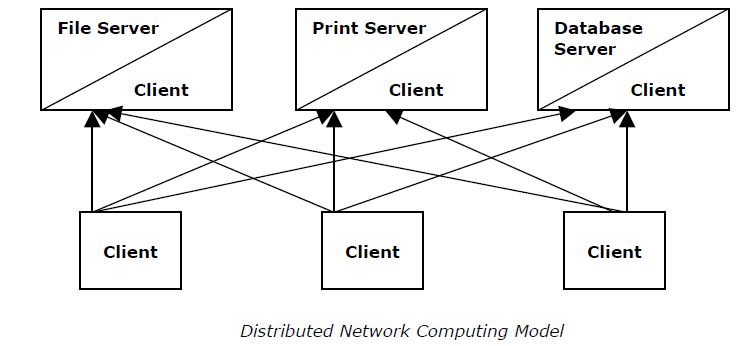
The distributed network computing model allows all network computers to take part in processing but at their respective ends, separately. This model allows sharing data and services but does not help the other network computers in processing.
In this network model, a processing-intensive task is broken into a subset of tasks and distributed among multiple nodes. The nodes work on their individual subsets of tasks. The following figure shows the distributed network computing model:


Advantages
Some of the advantages of the distributed network computing model are:
  • Faster data access: The distributed network model allows a node to store the information locally. As a result, data can be accessed faster than in the centralized network model.
  • High reliability: In the distributed network model, no single point of failure exists because the network does not entirely depend on a single node. This ensures lower network downtime.
  • Customized network setup: The distributed network model offers the flexibility of treating different computers as clients and servers. It allows the optimized use of resources because the roles of the server and the client are interchangeable.
    

CENTRALIZED NETWORK COMPUTING MODELS

Network Computing Models


A network can be designed for processing information by either the client or the server. The network model can also be structured in a way that both the client and the server can process information. Depending on this flexibility, network computing models can be of three types:
Centralized network computing model
Distributed network computing model
Collaborative network computing model

Centralized Network Computing Model
In the centralized network computing model, the clients use the resources of high-capacity servers to process information. In this model, the clients are also referred to as dumb terminals with very low or no processing capability. The clients only connect to the server and not to each other. The following figure shows the centralized network computing model:


Advantages
Some of the advantages of the centralized network computing model are:

  • Centralized data management: In a centralized network computing model, data is stored on the server. This increases the reliability of data because all data modifications are stored at a central location.
  • High level of security: The centralized network computing model is a highly secure network model. This is because network security can be implemented and monitored centrally from the server.
  • Cost effectiveness: High-end investment is required for establishing a high-capacity and secure server. On the other hand, clients require very low investment. This reduces the overall cost of setting up a centralized network.


Limitations
The centralized network computing model is a conventional model that is used only by a few network setups due to the following limitations:

  • Low performance and network speed: The centralized network computing model consists of a server that manages numerous requests, simultaneously. This increases network traffic, consequently reducing the speed and performance of the network.
  • Central point of failure: The server is the central place for storing data and processing all client requests. If the server fails, the functioning of the entire network is disrupted.


Monday, April 4, 2011

WIDE AREA NETWORK AND INTERNET CONCEPTS

WIDE AREA NETWORK AND INTERNET CONCEPTS


A wide area network (WAN) is very similar in concept to a widely distributed client/server LAN. In a wide area network, some distances typically separate computers. A typical WAN is a local city- or countywide network, like the one in the following figure. This network links network members together through a Bulletin
Board Service (BBS). Users can access the bulletin board’s server with a simple telephone call.

A Country-Wide Network

Several types of communication systems connect WANs together. These communication paths are referred to as links. In some areas, high-speed intermediate-sized networks, referred to as Metropolitan Area Networks (MANs), are coming up. These networks typically cover areas up to 30 miles or 50 kilometers in diameter and are operated to provide access to regional resources. They are like LANs in speed and operation, but use special high-speed connections and protocols to increase the geographic span of the network, like a WAN.


The most famous WAN is the Internet. The Internet is actually a network of networks, working together. The main communication path for the Internet is a series of networks, established by the U.S. government, to link supercomputers together at key research sites. This pathway is referred to as the backbone and is affiliated with the National Science Foundation (NSF). Since the original backbone was established, the Internet has expanded around the world. It offers access to computer users in every part of the globe.

The TCP/IP protocol divides the transmission into packets of information, suitable for retransmission across the Internet. Along the way, the information passes through different networks that are organized at different levels. Depending on the routing scheme, the packets may move through the Internet using different routes to reach the intended address. At the destination, the packets are reassembled into the original transmission.
The packets movement around the Internet is shown in the following figure.

Data Packet Moving Through Internet

As a message moves from the originating address to its destination, it may pass through LANs, mid-level networks, routers, repeaters, hubs, bridges, and gateways.
A mid-level network is simply another network that does not require an Internet connection to carry out communications.
A router receives messages, amplifies them, and retransmits them to prevent the messages from deteriorating as they travel.
Hubs are used to link networks together, so that nodes within them can communicate with each other.
Bridges connect networks together, so that data can pass through them as it moves from one network to the next. A special type of bridge, called a gateway translates messages as they pass through, so that they can be used on different types of networks, such as Apple
networks and PC networks.